

county introduction
One county, many layers
Chester County makes more sense when its homelands, changing boundaries, farms, industry, freedom struggles, and public places are read together.
People, places and changing landscapes
Read the county in chapters, then follow the dates. Each story stays here to read and keeps a path back to the original record.
History here has more than one beginning, and it is still being made.
Start with a chapter
county introduction
Chester County makes more sense when its homelands, changing boundaries, farms, industry, freedom struggles, and public places are read together.
community history
The archive records systems of enslavement; Black students, soldiers, and veterans built institutions that changed the county’s future.
place history
The 1777 Philadelphia Campaign moved across fields, roads, and households; the famous encampment began in a place people already worked and lived.
institution history
From Ashmun Institute’s 1854 charter to today’s Lincoln University, a southern Chester County campus has made education part of the freedom story.
A source-linked chronology
Across eras
The Delaware Nation describes the Lenape as having ancestral homelands in eastern Pennsylvania and recounts forced removals. Today’s county lines do not define Indigenous identity or sovereignty.
Regional context; the cited account is the Delaware Nation’s own and does not stand in for every Lenape or Delaware Nation history.
HistoryBefore 1800
Pennsylvania’s archives list Chester among the original counties established in November 1682.
The original county covered land later divided into several present-day counties.
County courthouses and formation datesBefore 1800
The Pennsylvania House history records an Assembly session at Upland, then part of Chester County; Upland is now in Delaware County.
Historical county geography differs from current municipal and county boundaries.
History of the HouseBefore 1800
The Chester County History Center identifies a surviving record in which the clerk used “Court of Chester for County of Chester” instead of “Court of Upland.”
County government record; terminology reflects the period’s changing institutions.
For the County of Chester: the oldest record at the Chester County ArchivesBefore 1800
The new county boundary reduced the area administered as Chester County.
Colonial Pennsylvania county formation.
County courthouses and formation datesBefore 1800
The Delaware Nation recounts the Walking Purchase as a coercive colonial land taking that affected Lenape people in the region.
Regional Indigenous history; this summary follows the Delaware Nation’s account and does not imply consent or a simple, uncontested land transaction.
HistoryBefore 1800
British and American forces fought at Brandywine during the Philadelphia campaign of the Revolutionary War.
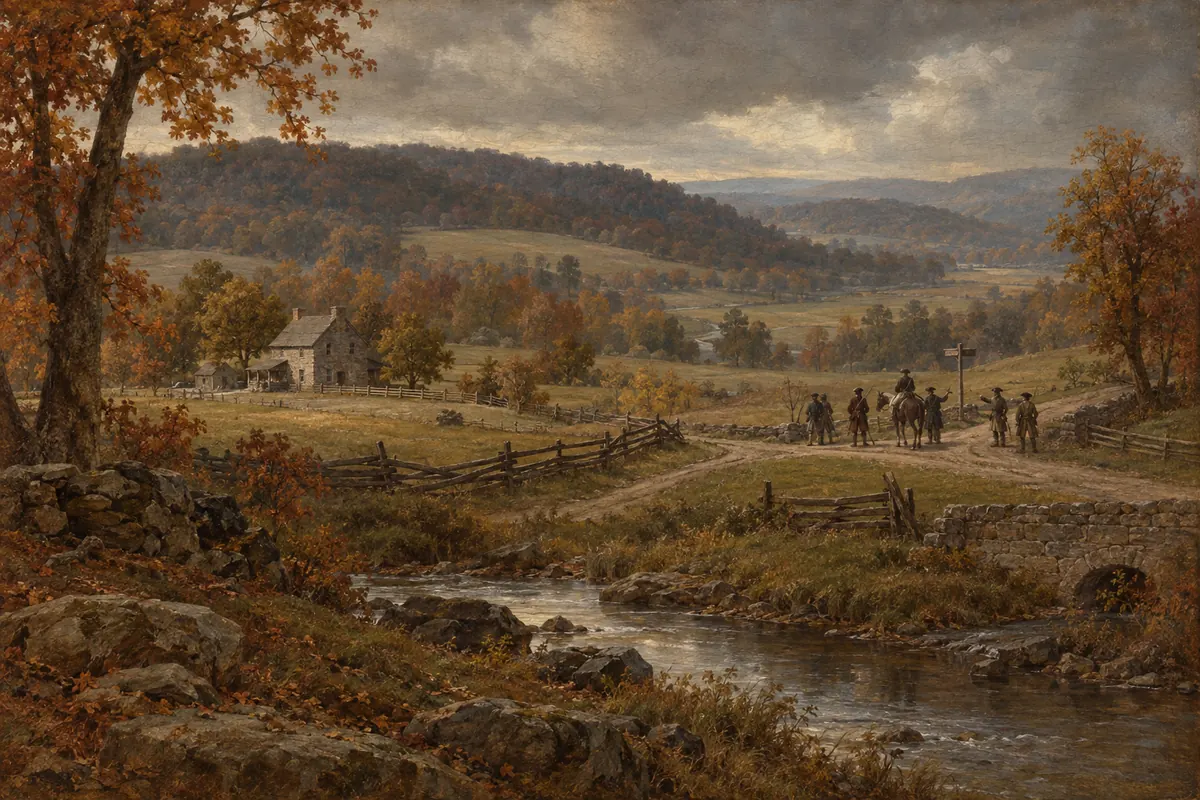
Battlefield locations span present-day Chester County and nearby areas; the cited NPS account gives the campaign context.
The Philadelphia Campaign of 1777Before 1800
The Battle of Paoli followed the Brandywine fighting as British forces advanced toward Philadelphia.
Present-day Chester County battlefield and Philadelphia campaign context.
The Philadelphia Campaign of 1777Before 1800
The Continental Army occupied a farm-and-forge landscape for six months; local households and a diverse camp population experienced the encampment in different ways.
Valley Forge National Historical Park spans present-day Chester and Montgomery Counties.
What Happened at Valley ForgeBefore 1800
Pennsylvania’s gradual abolition act changed the law over time; it did not immediately free every person who remained enslaved.
State law with consequences for people in Chester County and Pennsylvania.
Slavery and Underground Railroad resourcesBefore 1800
A new county line changed the boundaries of Chester County again.
Pennsylvania county formation.
Facts About Chester CountyBefore 1800
County heritage materials describe an early forge in the Hibernia iron-making landscape during the 1790s.
Hibernia, present-day Chester County.
History and Architecture1800–1899
County heritage material associates Charles Brooke with the Hibernia iron works in the early nineteenth century.
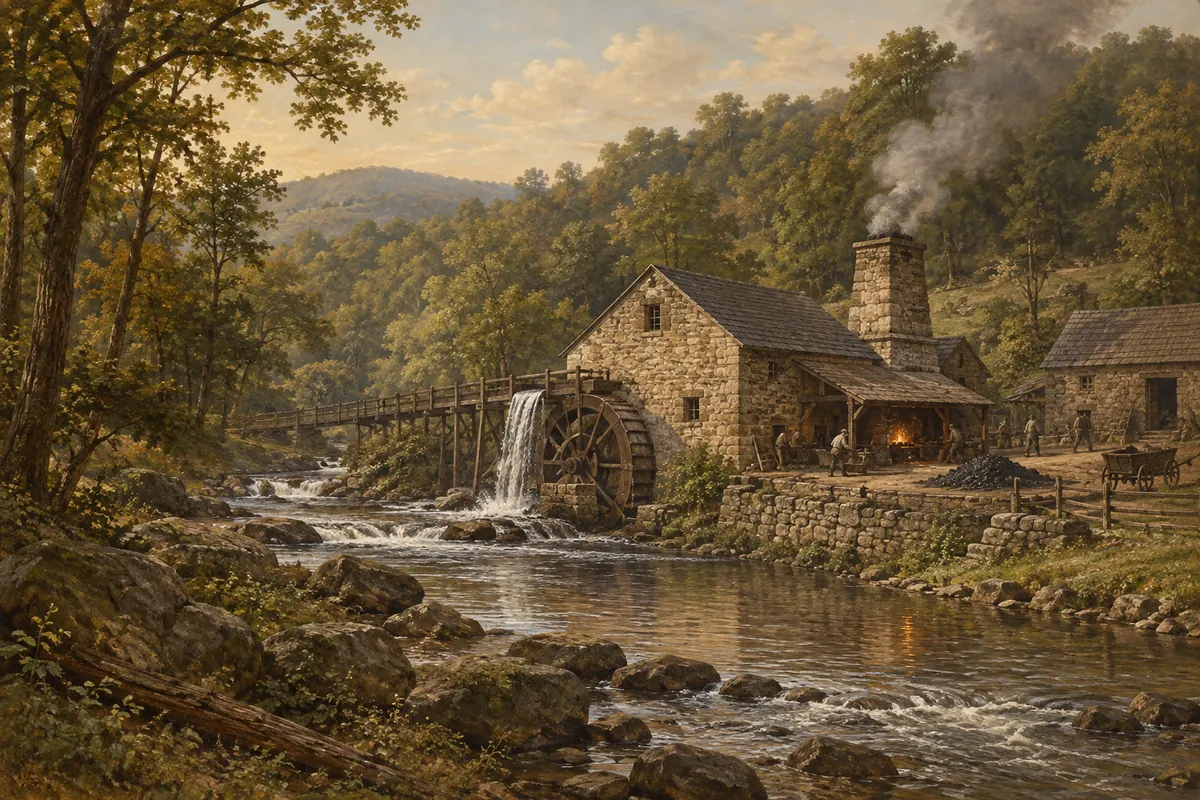
Hibernia, present-day Chester County.
History and Architecture1800–1899
The route later used by Struble Trail follows a former railroad corridor serving communities along the East Branch Brandywine.
Downingtown and the East Branch Brandywine corridor.
Struble Trail1800–1899
The school founded in southern Chester County became Lincoln University, a living center of Black higher education.
Southern Chester County; today’s Lincoln University.
History1800–1899
The County’s account of the former New Holland line describes a Downingtown–Waynesburg section by 1861.
Rail corridor later repurposed as Struble Trail.
Struble Trail1800–1899
The Phoenixville industrial heritage organization describes the Phoenix column, patented and produced in 1862, as a contribution to iron construction.
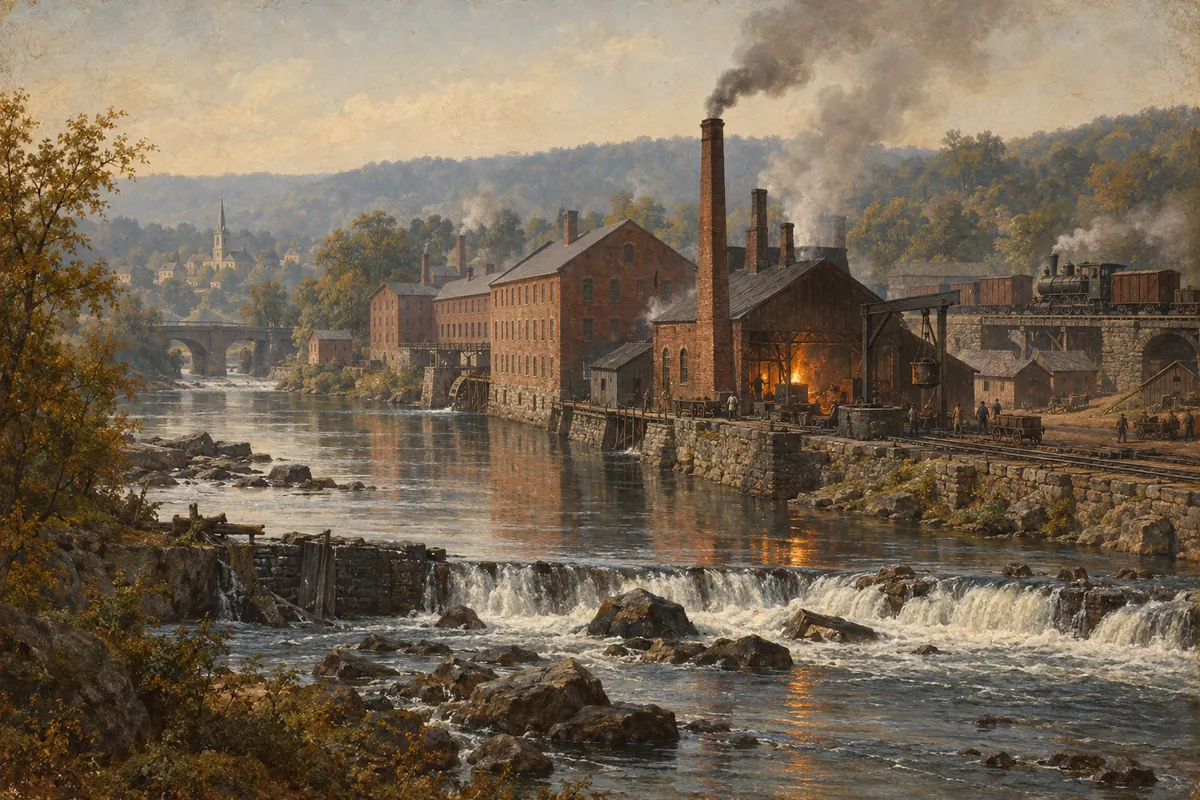
Phoenixville manufacturing; the product was used in structures beyond Chester County.
Phoenixville Iron and Steel Company1800–1899
The County’s index identifies 134 Chester County African American soldiers in the 3rd United States Colored Troops, the largest contingent it lists for a regiment.
Local enlistments; the regiment mustered at Camp William Penn outside Philadelphia.
Chester County USCT Index1800–1899
County heritage accounts place the end of iron production at Hibernia in the 1870s.
Hibernia, present-day Chester County.
History and Architecture1800–1899
The Chester County History Center records the Daniel Reed Grand Army of the Republic Post as an African American post that met in Coatesville.
Coatesville; Black veterans’ civic organizing.
Grand Army of the Republic Collection1900–present
The Pennsylvania Historical and Museum Commission links national outrage over Walker’s lynching with momentum for the state’s 1923 anti-lynching law.
State law; its context includes Coatesville and the national anti-lynching movement.
PHMC Annual Report 2006–2007, historical marker report1900–present
The PHMC marker report says Dr. Atkinson founded a hospital offering care regardless of ability to pay, an institution serving people facing barriers to care.
Coatesville; Black medical leadership and local health care.
PHMC Annual Report 2006–2007, historical marker report1900–present
The County’s parks history traces the start of its modern county park program to a parks board formed in 1958.
Chester County.
History of Chester County’s Parks & Trails1900–present
The parks history records the County’s first park purchase as an early step toward a public parks system.
Chester County.
History of Chester County’s Parks & Trails1900–present
Nottingham County Park was dedicated as Chester County’s first county park.
Nottingham, southern Chester County.
History of Chester County’s Parks & Trails1900–present
The County parks history records the acquisition of Hibernia as a county park in 1964.
Hibernia, present-day Chester County.
History of Chester County’s Parks & Trails1900–present
The County parks history dates Warwick County Park’s addition to the park system to 1973.
Warwick Township.
History of Chester County’s Parks & Trails1900–present
The former rail corridor became a public hiking and biking trail named for Robert G. Struble.
Downingtown and East Brandywine corridor.
Struble Trail1900–present
The County Archives began preserving and providing access to enduring government records.
Chester County government records.
Archives & Record Services1900–present
Springton Manor Farm opened to the public as a county park with its agricultural landscape and historic buildings.
Glenmoore area.
History of Chester County’s Parks & Trails1900–present
The County’s parks chronology records expanded open-space purchases and basin projects during the 1990s.
Countywide open-space program.
History of Chester County’s Parks & Trails1900–present
The County chronology marks the trail’s demonstration phase as an early step in a regional multi-use route.
Chester Valley and regional trail corridor.
History of Chester County’s Parks & Trails1900–present
A former river desilting basin becomes a public wildlife sanctuary and interpretive site.
Schuylkill River near Phoenixville.
History of Chester County’s Parks & Trails1900–present
The County adds a large natural area along upper Octoraro Creek to its park system.
West Nantmeal Township area.
History of Chester County’s Parks & Trails1900–present
The County parks chronology records an early completed phase of its Schuylkill River Trail section.
Phoenixville and the Schuylkill River corridor; total mileage remains conflicted across County pages.
History of Chester County’s Parks & Trails1900–present
The County’s park chronology records Exton County Park opening; current County material says the developed public recreation area is only one part of the larger joint property.
West Whiteland Township; distinguish the developed site from the broader ownership area.
History of Chester County’s Parks & Trails1900–present
The County reports 1,558 farms and 143,442 farmland acres in the 2022 USDA Census of Agriculture.
Chester County; a statistical snapshot rather than a single historical event.
Facts About Chester CountyChoose another date range, or return to the full timeline.
This is an evolving guide, not the whole story. Suggest a correction or source.