
Borough guide · Central Chester County
West Chester
A courthouse town shaped by county government, local nurseries, Black institutions and streets whose history reaches well beyond the storefronts.
This guide follows West Chester Borough’s municipal boundary. Nearby townships and places that use a West Chester mailing address may have different services and boundaries; use the Borough’s address tools when jurisdiction matters.
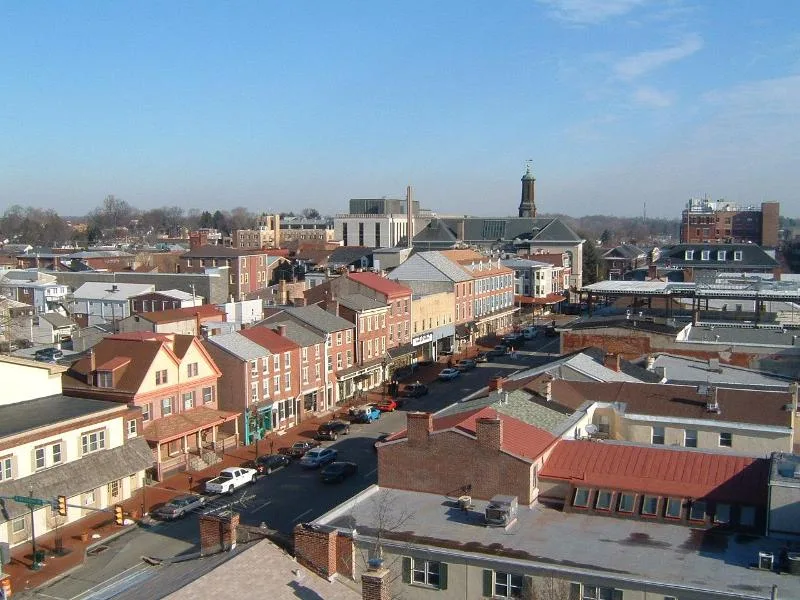
Photo unavailable. The local story and source links are still here.
Turk’s Head became a county seat
The Borough’s historic-district guide traces West Chester to Turk’s Head Tavern. In 1784 the county chose the site for its new seat; court began in the courthouse by 1786, and the name West Chester was adopted in 1789. The borough charter followed in 1799. These dates explain why court buildings and county offices anchor the town’s older street plan.
That same account says the 1799 borough limits have remained unchanged. The familiar place name reaches beyond that line, so use West Chester Borough’s address lookup when a permit, election district or municipal service depends on jurisdiction.
Black civic life appears in the town record
The Borough’s history guide reports that an 1857 directory listed 443 African-American residents—about a tenth of the borough’s population by 1860—and dates Bethel A.M.E. Church to 1816. That is evidence of a substantial Black community and an early institution, not a complete picture of its members or their lives.
Reading the directory alongside present-day sources from local Black institutions can reveal more than the older architectural survey preserves. This guide keeps the number tied to the Borough’s cited directory and does not treat one municipal history as the whole record.
Nurseries and schools were part of the economy
West Chester’s history was not only courts and shops. The Borough guide describes a large nineteenth-century nursery trade: Hoopes Brothers and Thomas sold nearly 900,000 fruit-tree seedlings a year in the 1890s, while the Normal School—today’s West Chester University—opened in 1870. A rail branch, financed locally, had already reached the main line in 1832.
Those accounts make the streets legible as working infrastructure: a county center connected farms, buyers, learners and rail passengers. The figures come from the Borough’s 2002 design guide, a useful historical summary rather than a current economic measure.
A park can carry a biography
Bayard Rustin Park opened as Walnut Street Park in 1939 and was renamed in 1998 for Rustin, the West Chester-born civil-rights organizer. The Borough lists the park at dawn to dusk and publishes its own features and conditions. It is a present public place with a specific local history, not a substitute for a biography or the wider record of the movement.
For a deeper look at how streets changed, the Borough’s Time Warp map offers aerial imagery back to 1935. The Chester County History Center publishes its own visitor information and collections links; check both institutions directly before planning around a visit.
Public places and direct links
Good starting points
Schedules and conditions change. Open the source before making a special trip.
Borough park · West Chester Borough
Bayard Rustin Park
The Borough lists the park’s dawn-to-dusk hours, facilities and local history. Check that page for current conditions before going.
History museum and archives · West Chester
Chester County History Center
Follow the institution’s current visitor page for location, hours, admission and research information.
Farmers market · West Chester Borough
West Chester Growers Market
Use the market organizer’s own calendar for current market dates and vendor details.
Sources and review dates
Historical notes and current visitor links were checked on the dates shown. They support the claims above; they do not guarantee future hours, access or conditions.
- Design Guidelines for the West Chester Historic District ↗West Chester Borough Historical and Architectural Review Board · checked 2026-10-03
- Bayard Rustin Park ↗West Chester Borough · checked 2026-10-03
- Data & Map Services ↗West Chester Borough · checked 2026-10-03
- Visit Us ↗Chester County History Center · checked 2026-10-03
- West Chester Growers Market ↗West Chester Growers Market · checked 2026-10-03